“Live, travel, adventure, bless, and don't be sorry.”
Jack Kerouac

Sunday, November 20, 2011

Villages.

My home for two months.  Temple on left.  Clinic and and living quarters on right.
Saturdays are much anticipated days off.  After six straight days of treating patients at the clinic a refreshing day to relax, explore and re-engergize is welcomed.  Instead of traveling back into Katmandu, a few of the practitioners and videographer decided to spend this last saturday trekking across the countryside outside of Chapagoan to visit some quieter and more remote villages.  Along the way we encountered curious locals who were quick to welcome us for tea and conversation.  Children followed us at various points along the dirt roads wondering about our cameras and were easily entertained by seeing pictures of themselves.  One family invited us to join them on their porch for milk, a Nepali language lesson as well as a mustard oil harvesting demonstration.  The landscape was scattered with terraced agriculture fields and steep foothills of the Himal.  Many locals were cleaning laundry or themselves at the community water sources or out tending to the fields.  On our way back to Chapagoan a generous driver offered us a ride in the back of his dumptruck for the remainder of the journey.  After six hours of trekking we graciously accepted his offer and rode the rest of the way over the mountain pass back to town in style.......on the top of several tons of crushed rock!
Street in Chapagoan near the clinic.
Corn and laundry drying as families socialize in front of their houses.
Workers taking a break from the rice terraces.
Woman cleaning at the community water source while a goat watches from the first floor of her house.
"Little monks" watch the camera in amazement as Tristan films another monk caring for a injured bird.  
Road leading out of Chapagoan toward the smaller villages.
Typical scene during the trek from village to village.
Suspension bridge over deep canyon leading to one of the small villages.
Village street where we stopped for curry potato pastries and a beer.
The landscape with small villages in the background.

Wednesday, November 16, 2011

Grateful.

Almost a week has past since I began working as a practitioner with the Acupuncture Relief Project in Chapagoan, Nepal.  Although I can't find the words to adequately describe the experience so far, I did want to express how grateful I am for all of you that have supported the project and my participation.  So,  today I chose to share a few pictures of my own and provide two resources that also capture what this experience is about.  Since our arrival the team of practitioners has been being filmed for a short documentary about the project. Tristan Stoch is a videographer and documentary film maker from Portland, OR and has done a remarkable job capturing the essence of this journey so far via video and photography.  Please take a look at his blog for a unique visual prospective about his experience with the project thus far.  http://tristanstoch.tumblr.com/. The Acupuncture Relief  Project's blog site also provides first hand accounts of practioners' recent experiences with the clinic along with some great photos of the clinic and surrounding area. http://www.acupuncturereliefproject.org/news-blog. Once again, thank you for supporting me with this adventure.  I hope you enjoy the resources as much as I enjoying sharing them with you!

Sleeping on the job.
Grains, beans and spices on the street.
View of Thamel from the Hotel in Katmandu.
Working in the fields near the Clinic.
Team being filmed in the streets of Katmandu by documentary filmmaker Tristan Stoch.
Himal at dusk from the clinic.
Rice fields in Chapagoan near the clinic.
Monkey business in Katmandu.
Hanging out in Boudha.

Sunday, November 13, 2011

Namaste

The first piece of advice I received before stepping out the hotel's front door to walk the streets of Katmandu from Andrew, the project's president shortly after arriving in Nepal was, "make sure you yield to anything bigger than you".  Seems like a simple enough concept for anyone to understand and applies to just about any environment where you travel, right?  I learned quickly that although this advice was accurate and helpful, it only applies to places in the city where there is actually a space to yield!
Walking around Katmandu is not easy.  Matter of fact, the simplest of jaunts around city blocks ( or lack of) is downright mentally and physically exhausting.  Sidewalks barely exist.  When they do they are often uneven, rugged and full of holes. Walking on the streets is more common but the conditions are usually worse than the sidewalks.  Sometimes gravel.  Sometimes brick. Sometimes pavement.  They are always full of potholes, scattered with animal waste, sewage sludge and trash.  And traffic.  Lots of traffic. So as one eye is watching the ground where you step to keep forward momentum the other is making sure you do not get hit, knocked down or run over.  Either by motorcycle, car, van, bus, rickshaw, cart, tractor, bicycle, pedestrian, young children or livestock.  Cattle roam freely on the streets.  So do ducks, geese, chickens, goats and dogs but they present less threat.  At the same time your senses begin to become stimulated often to the point of becoming overwhelmed.  Horns beeping, engines rumbling, sirens blaring, school kids yelling, dogs barking, whistles blowing and chanting all fill your ears.  The smell of sewage, burning fuel, incense, trash and meals being prepared provide a contrasting fragrance.   Bright colors illuminate narrow alleys from shops, markets, homes and temples making many areas blend together creating a maze where it becomes easy to get lost.  And the energy from the city's movement is felt radiating through your body.  It is only when you are able to stop and slow down that you begin to notice the little things that are special and unique.  You can begin to focus on the beauty and character of the people and their culture.  You notice the passion and begin to understand the spirit in their beliefs.  You see the beauty in the architecture and the connection to history. Consequently, everything that once seemed so foreign and obscure begins to become comfortable, common and familiar.  Eventually, "yielding" becomes an adventure overcome by an unconscious competency while exhaustion transforms to enlightenment and joy.  But at some point you must walk again and the cycle starts all over.
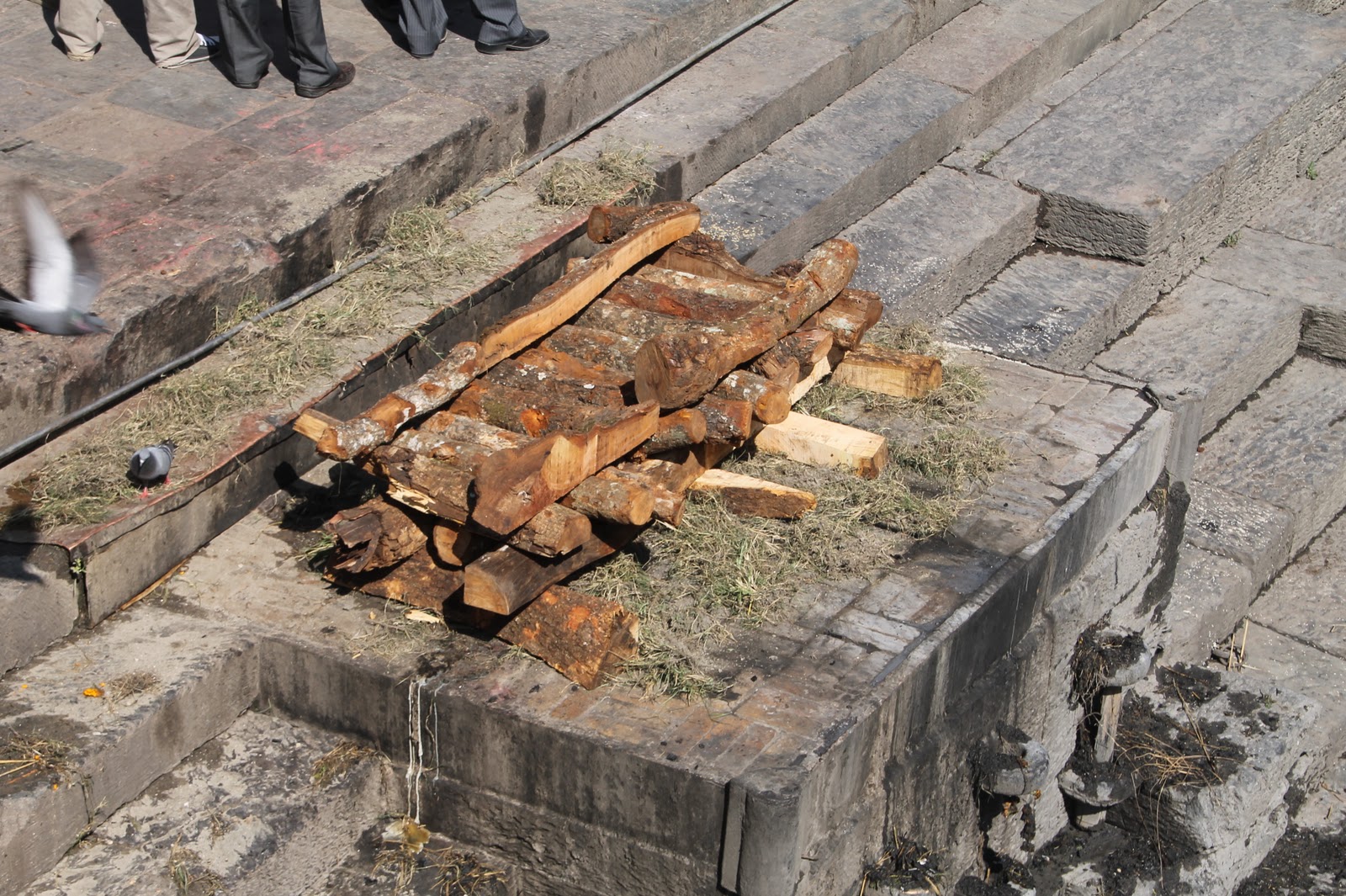
Log Pyres
Funeral preparation
Oldest son's hair removal before his parents cremation.
Cremation ghats
fertility temples
Boudha Stupa
Bouhda Stupa
Hindu funeral
The eyes of Buddha on the Great Stupa
fertility temples
The deceased having their feet cleansed before cremation.
Y,ou can get your picture taken ( for a fee) with a "fake" holyman in tourist areas.
The first two days after arriving were spent getting to know parts of Katmandu and the other practitioners making up our clinical team.  As a group we explored some of the more popular tourist sites including the holy area of Pashupatinath, Boudhanath and Durbar Sqaure.  The Pashupatinath is Nepal's most sacred Hindu cremation site.  Along the Bagmati river log pyres are situated on cremation ghats where bodies are carried to by barefooted pallbearers.  Once there, the body is lowered into the river and the feet are washed. After the oldest son's hair is cut he performs the rites which includes filling the mouth of the deceased with fuel to begin the cremation process.  Once the body is in flames the mourners retreat to observe the process along the banks of the river along with anyone else who care to witness the open air ceremony.  A few hours later the ashes are swept into the river.  Along the opposite side of the river are fertility temples where new life is celebrated and worshipped. The Boudhanath is the home of the Great Stupa where the practices of Buddhism is showcased.  The eyes of the Buddha are situated at the highest point of the Stupa just above the symbol representing the concept of one.  Crowds of people walk clockwise around the Stupa for ritual all hours of the day.  Durbar Square is Katmandu's old city center with temples dating back to the 12th century.  In the square is the Kumari Bahal which is home of the young girl chosen to serve as the Royal Kumari.  She is considered the emanation of the fierce Hindu goddess.  She only makes appearances in public at festivals otherwise sitings are considered an honor and happen rarely. On the day of our visit she did provide us a glimpse as she revealed her painted face briefly through her upper window.  Pictures of the Kumari are absolutely forbidden.  In addition to observing these sites, we leisurely explored the streets of Thamel and Boudha looking through shops and sampling the local cuisine of daal bhaat  and rice dishes fried with water buffalo.  Once we "settled" in, recovered from jet lag and got adjusted to the pace of the city some last minute supplies where purchased as we prepared to relocate to the village of Chapagoan to begin practicing in the Vajra Varahi Healthcare Clinic.

Saturday, November 5, 2011

The Dawn of the Dog.

On the walk.

Time For Lime staff having afternoon dog walk on the beach.
Lanta Animal Welfare Clinic.
Fire juggling.

 The day was October 31, 2011.  Halloween day on the south end of Hat Khlong Dao beach situated on the western shore of Koh Lanta Yai island.  At 9:30 am the temperature outside was at least 90 degrees with 100% humidity.  The sun was hot and the slight eastern breeze did little to cool the body or detour my clothes from sticking to my sweat saturated limbs.  The intermittent rumbles and roars of long boat and motorcycle engines hummed in the background like thunder in a passing storm.  The smell of burning coconut from cleared construction sites as well as charcoal from the “rot ken” (vendor carts) filled the air with a smokey fragrance.  At the same time, the tide of the Andaman Sea rhythmically settled in along the white sandy beach in a calming manner in front of the porch where I was resting.  There where no carved pumpkins.  No ghosts, goblins or ghouls.  No recordings of frightful sounds to be heard or toilet paper hanging from the branches of the trees.  Nobody was wearing costumes.  There wasn’t a hint of organized haunting or the celebration of evil spirits anywhere to be seen.  Matter of fact, the only scary experience that can be noted was opening the “not so” hard boiled egg I was gifted to for breakfast by a Thai man whom I believed to be the caretaker of the guesthouse. And I will admit that the first sip of instant coffee sent creepy chills down my spine and the ants in the sugar jar startled me slightly.  Other than these mildly frightful experiences this Halloween would be more surprising than scary and a reminder that I am far from home.
I enjoy unexpected surprises when traveling.  Not the kind that leave you wondering where your backpack ran off to or why there is no money in your wallet. Or the kind that compromises your safety and health.  In contrast, its the kind of experience that happens without planning and somehow leaves a lasting impression on you about the culture, community and individuals that your visiting.  This is exactly what happened when we discovered that the cooking school and guest house that we stayed at donates 100% of their earnings as a non-profit organization to the Lanta Animal Welfare Shelter on the Island.  
Over ten years ago the owner of the Time For Lime cooking school came to Koh Lanta to follow her first passion,Thai cooking.  She stayed because of her  second.  Helping dogs and cats.  When Koh Lanta began to develop as a travel destination construction workers from various parts of the mainland arrived to build resorts and infrastructure.  They brought dogs and cats with them to “take care” of the job sites.  When construction ended the workers returned home and left the animals on the island.  They were no longer needed.  Once resorts were established, owners would “adopt” dogs and cats for the tourist high season because westerners viewed these animals as pets and created a welcoming presence.   Once the tourists left the animals were either left to fend for themselves or abused in attempts to encourage them to leave the property.  Soon a large population of feral beasts began to multiply (gremlin’s reference) and take over the island like crazed zombie’s.  Soon, the only means for locals to protect themselves from the horror of these overpopulated disease ridden monsters was to kill, abuse and mistreat.  Common cruelty includes burning with hot cooking oils, knifing, attaching weight and being throw in the sea as well as poisoning and beatings with bamboo.  Although the the island is rich in culture due to the fact that most of the local residents are decedents of Muslim Malay, animals are not viewed as pets.  They are a nuisance.    As long as they continue to re-produce the dogs and cats really do not stand a chance.  The cycle will continue.
The overall mission of the Lanta Animal Welfare Shelter is to sterilize the dogs and cats on the island while educating the local residents of the importance of having dogs and cats spayed and neutered.  In addition they rescue and attempt to rehabilitate abused or mistreated animals and provide adoption services with the resources available.  The entire clinic is managed by volunteers and funded by donations and the Time For Lime cooking school and guest house.  They also seek daily volunteers to walk the dogs that are currently seeking homes.  Since Jennifer and I where missing our adopted dog Stella and cat Jui from home, we decided to volunteer our afternoon to walk a few dogs at the shelter.  This experience brought smiles to our face and felt fortunate we could help the other volunteers and animals in some little way.  The two dogs we walked, Mai-tai and Lee-lah seemed appreciative for our time together.  The feeling was mutual.  We even let them enjoy what Jennifer referred to as “island jerky”.........a road killed frog. Until they began to roll in it.
taking Mai-Tai and Lee-lah to the water.
Sunset.
Halloween!
On our way back to the guest house in our tuk-tuk we happened to be surprised again by noticing a flyer announcing a Halloween party at a local bar called Irie.  Since it was Halloween day, it just seemed appropriate to attend.  You even got a free drink if you were wearing a costume.  Jennifer was prepared for this part of logistics having apparently carried devil horns and a butterfly mask around China for five weeks in her luggage in anticipation of such a event.  Serendipity, coincidence or just plain old fashioned luck our evening was set and we where going to celebrate Halloween after all.  We were welcomed curiously by the local staff and entertained by techno versions of Michael Jackson’s Thriller and M.C. Hammer in the midst of laser lights and barbecue smoke.  Fire torches were juggled precariously by one ambitious and entertaining staff in the middle of the crowd and thatched roof enclosure.  One false move and the place is up in flames.  The local staff appreciated our adventurist spirit and by the end of the night was offering advice on recommendations for the rest of our stay on the island.  This information proved to be valuable and ironically enough we would cross paths with our new friends many times all over the island. When we arrived back at the guest house later that evening we were eerily greeted by a black cat lounging on the front porch.  As our thoughts swirled with images of a unique Halloween, we hesitantly fell asleep to the chilling sounds of scraping lizard claws on the floor and walls of the room.

Wednesday, November 2, 2011

Cooking Thai.

yes!

 After a week or so of indulging in some of the best and unique foods we have experienced to date it soon became apparent that we wanted more.  So we decided to learn a few tricks of the trade of Thai cuisine.  Jennifer and I took part in a Thai cooking class at the Time For Lime (http://www.timeforlime.net/ )cooking school and guest house located on Hat Khlong Dao beach on the western shore of Koh Lanta Yai.  We both share most of the same passion and enjoy the culinary pleasures of Thai cuisine and decided we could benefit from becoming educated to prepare these meals for ourselves and friends.  With about ten other individuals (representing 9 countries) we prepared, cooked, discussed and  sampled  Thai dishes such as massaman curry, crispy spring rolls, spicy seafood salads and winter squash curry soup (Time For Lime specialty soup).  We learned about the three “s” theory to Thai seasoning and flavor.  In the pre-test I was certain that one of the “s” stood for spicy.  On the contrary, spicy is an added element to a dish.  It is common for  locals to include up to fifteen chili’s to add hot spice to a dish.  I found this to be amazing since I could barely go for three in my prepared dish!   The three “s” stand for salty, sour and sweet.  It is this combination of flavor that is essential to all Thai dishes.  The first item we sampled was a bite sized “taste of Thai” which included all the general flavors of Thai cuisine in one bite.  It consisted of minced shrimp, peanuts, ginger, fish sauce, garlic, tamarind paste, and birds-eye chili’s all wrapped up in one kaffir leaf.  In addition, we learned about the correlation between how vegetables are cut and what they are intended for.  For example, thinly sliced items like ginger, lemongrass, kaffir leaves and chili’s are for you to eat with the dish and the larger pieces typically cut at a slanted angle are solely for flavoring purposes.  So its proper to leave food like galangal root in your bowl or on your plate.  That’s the way the dishes were intended to be consumed.  Another interesting and helpful piece of information was about how to eat (etiquette) Thai cuisine.  Apparently, the use of chopsticks is rare and the only utensil that goes into the mouth is the spoon.  The fork’s sole purpose is to assist the knife in the cutting of the food.  Only the right hand should be used if needing to eat with when eating “finger food”.  The left hand is to be used for certain hygienic bathroom rituals that won’t be discussed here.  I wish I had known this about a week earlier.  There is good possibility that I offended others and probably the reason why a bowl of hot lime water was brought to my table after eating fish with both of my hands!  After five hours of cooking, eating two of our prepared meals and a few lemongrass margaritas, it was off to bed dreaming of birds-eye chili peppers jumping over the moon.

Jennifer's massaman curry and spring roll.

Spicy seafood salad and winter squash curry soup.

Essential Thai ingredients.

Saturday, October 29, 2011

Portland, Oregon 97213


When I think about Portland, Oregon the image of Mill Ends Park resinates through my mind. Originally created on St. Patrick’s Day in 1948 to be the only leprechaun colony west of Ireland, the park is located in the median strip of a busy downtown parkway.  The park also takes claim as the world's smallest, being a circle 2 ft across and a total area of 452 square inches.  Yes, this is a city park recognized and managed by Portland Parks and Recreation which,  awkwardly enough, seems to symbolize many traits and values of the city of Portland.  Both are smaller in size, unique in stature, quirky in personality, complemented by a bewildering sense of purpose and place all portrayed with confidence and pride.  Not to mention a good sense of humor.  Portland’s slogan is “the rose city” but has been affectionately labeled in some circles as," the place where young people go to retire" and is the setting for the television show Portlandia (http://www.ifc.com/portlandia/)  which takes stabs at the local culture with un-abandoned humor, sarcasm and wit.  It’s a place where forms of diversity (even if not completely understood) are mostly tolerated, accepted and often celebrated.  Ironically enough,  its this same diversity that creates factions of passionate individuals with a sense of entitlement that are so quickly to judge others.  So what if I forgot to bring a dog poop bag to the dog park, honked my horn at the bicyclist that ran a stop sign, put a glass bottle in the trash and forgot to bring my reusable grocery bag to Whole Foods!  I’ll probably never be able to afford solar panels on my house or the cute little water collection systems that will provide water for my non-existent garden next year and I might not vote or share the same passion about saving the pigeons downtown from extinction.  All generalities aside, this is one of the many reason s I have enjoyed Portland.  Its a place to challenge or be challenged with ideas, thoughts and creative expression.  To be yourself or get lost with everyone else.  Or just being able to be surrounded by something you can connect with. Or not. Its a place where nature co-exists with the urban landscape.  A place where neighborhoods embrace their ever-changing identity with creative ideas, businesses and events.  A place where animals have their own parks, bicyclists and pedestrians actually are respected and  have rights, and a free range organic buffalo burger can be washed down with a vegan beer at the local food cart.  It’s a place that I enjoyed calling home for a few years and know I will return often.  Over the last  week I have had the opportunity to mourn over my departure as well as reflect about all the wonderful attributes and experiences that the great place of Portland has offered and provided for me.  To honor this, I have created my " top ten best things about Portland" list.  Goodbye Portland for now. You will be missed.
 Portland Timbers:
The best sports team in America supported by passionate fans.  Seeing games at Jen Weld Field has rekindled my interest in soccer and the belief that American Soccer can be the best in the world one day.  http://www.portlandtimbers.com/
 Last Thursday:
Celebration of the arts on Alberta Street in Northeast Portland.
http://lastthursdaypdx.ning.com/

Pho:
The classic vietnamese noodle soup that is great on those dark, cold rainy winter days.   http://en.wikipedia.org/wiki/Pho 
Microbreweries:
More here than any other place in the world!  Favorites include the Laurelwood, Lucky Lab and Breakside Brewing. http://oregonbeer.org/ 
The Rain:
Yes, you read this correctly.  There’s something about its consistency that I enjoy and I am a Pisces.  http://portlandor.about.com/od/cityservicesgovernment/a/PDX_weather.htm
Portland Parks: 
There everywhere and important to the city. My favorites include Mt. Tabor, Forest Park, Sandy River Delta and the Sacajewa Dog Park.  http://www.portlandonline.com/parks/
Happy Hours:
There everywhere and you can get by on cheap eats almost any day of the week.  http://www.urbandrinks.com/happyhour/usa/or/portland
Laurelthirst Pub:
Music is free during the happy hours everyday and hosts performers like the Freak Mountain Ramblers and Jack Straw.   http://laurelthirst.com/ 
Multinomah County Library System:
Free and the selection of books, movies and music is unreal.  http://www.multcolib.org/
Location:
Worth mentioning:
Movie Madness, Brew theaters, Podnah’s BBQ, Coffee Shops, Powell Books.  

Monday, October 10, 2011

Headaches and the last minute details.

I have been thinking about headaches a lot lately.  Perhaps it is because most of the clients I have been working with having been dealing with tension headaches, or more likely that I am organizing all the final details as I prepare to drive across the country this Thursday.  I recently stumbled over this article and thought I would pass it along.  Enjoy.

tension

Use your hands to relieve tension headaches naturally

Thursday, March 24, 2011 by: Dave Gabriele


(NaturalNews) Sooner or later, we all get headaches. Usually, we tend to shut down the pain by taking an over-the-counter drug. Drugs are usually pretty good at removing pain, but they do not address the root cause of the problem and often cause unwanted side effects. Pain is actually very important because it is one way our body communicates a problem with us. By taking a drug to remove the pain, we only dull our senses. However, if we take the time to learn the language of our bodies, we can understand what the causes of our headaches are and address them directly. This is by far the healthiest course of action.

In the case of tension headaches, the culprit is usually tension in the upper back, shoulder and neck muscles. Here are six simple steps that will reduce or remove the pain associated with tension headaches:

1) To start, take yourself away from the computer screen, get comfortable and close your eyes gently. Take a deep breath and let out a long and relaxing sigh as you drop and relax your shoulders. Repeat this 3-4 times or as many times as you like.

2) Use your focus to release the tension in your upper body. Start with your face - take a few seconds to release all muscular tension and completely relax. Then move in a general backwards direction, continuing at the top of your head and then moving to the back of your head. Follow with your neck and finally your shoulders and upper back. Allow a few moments to completely relax each area.

3) Locate acupuncture point GB-20 on either side of the spine on the back of your neck just under the edge of your skull. Press firmly and deeply with your thumbs for about 1 or 2 minutes while keeping your breath gentle, deep and relaxed.

4) Put your hand on the back of your neck. Use four fingers on one side and the heel of your palm on the other side to grasp your neck. Start at the top of your neck and work your way down. Use firm pressure to grasp and then release the muscles a few times before moving down about a finger width and repeating. Massage all the way to the base of your neck about 5-10 times or until your hand gets tired, then switch hands and repeat.

5) Locate Acupuncture point GB-21 on the top of your shoulders half way from your spine to the outer edge of your shoulder. With the same "grasping" technique as #2, massage the muscle at GB-21 with the opposite hand for about 30 seconds to one minute. It will feel quite tender and sore since the muscles may be very tense. During the massage stay relaxed with soft and deep breathing. Switch sides and repeat.

6) Roll your shoulders in large slow circles to stretch and relax any tension that may be left in your shoulders and upper back. Roll them 5 -10 times in each direction while you keep your breathing even and relaxed. To finish, roll your head very gently around in a circle 5-10 times and then switch directions.

At this point, your tension headache should be either reduced or gone. If it is not, wait a few minutes and try again. However, this time do each step for twice as long and make sure to breathe in a deep but relaxed manner. Put an effort into becoming aware of any tension that you may be unknowingly holding in your body and let it go.

GB-20:http://www.holisticonline.com/remed...
GB-21:http://acupuncture.rhizome.net.nz/A...

Deadman, Peter (1998) A Manual of Acupuncture. England, Journal of Chinese Medicine.
Xiangcai, Xu (2002) Chinese Tui Na Massage. Boston, YMAA Publication.
Yang, Jwing-Ming (1989) The Root of Chinese Qigong. Boston, YMAA Publication.


About the author

Dave Gabriele, D.Ac, BA, is a registered acupuncturist, a practitioner of traditional Chinese medicine and a health researcher helping people in and around the Greater Toronto Area. He is the founder of Life Balance Family Health Care (www.balanceyourlife.ca), an organization committed to providing people with the information and guidance they need to make positive lifestyle changes. Dave has been a teacher of Chinese martial arts since 1997, including the arts of Taiji and Qigong.

Learn more:http://www.NaturalNews.com/031814_headaches_tension.html#ixzz1a2T5Bvc9